Why Does Kindness Make You Mad?
Me: please be kind - You: stop shoving your beliefs down my throat!

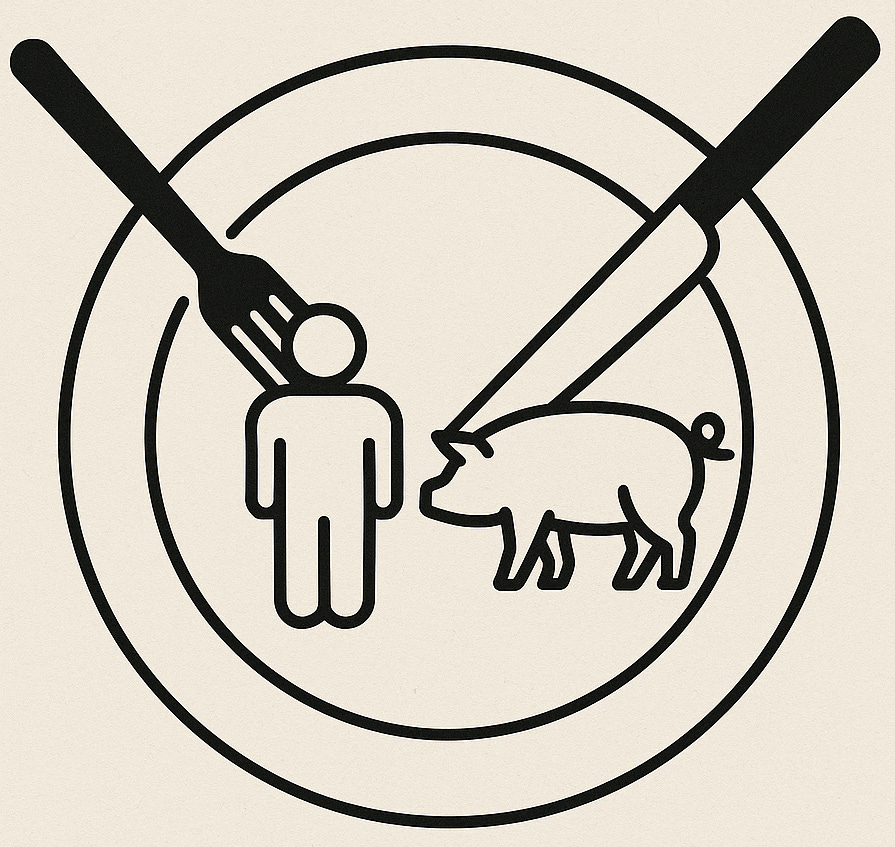
When I talk about other animals, people get mad.
Not because I’m yelling or shaming or threatening. But because I suggest something simple: kindness. I ask, do you have to eat other animals? We could be less harmful, less selfish, and more careful with how we treat others. And that suggestion alone is enough to spark outrage.
Which is odd, isn’t it? Because every single one of us is walking around with a mouth full of beliefs we didn’t choose—stuffed down our throats by our parents, schools, churches, cultures, governments. Beliefs about ownership. About hierarchy. About who's worth more and who's worth less. Beliefs that told us it was normal to cage, kill, and consume others without a second thought. But kindness? That’s the line too far.
And it’s not just about other animals. The same anger is conjured if you ask some people to be kind to human animals too: immigrants, for example, or trans folks, or children being starved and exploded by Israel. You’ll get the same knee-jerk rage. “They’re breaking the rules.” “They don’t belong here.” “They’re unnatural.” “They have the wrong religion.” “They’re not as smart.” “They’re taking something from us.” Never mind the history, never mind the facts, never mind the suffering, never mind the shared reality that we’re all living beings on this Earth. The common denominator is this: when you ask people to extend empathy beyond their tight little circle of sameness, they feel attacked. They lash out. They tell you you’re being unrealistic, irrational, too emotional. Or worse, that you’re the problem.
But it’s not really about the animals. Or the immigrants. Or the children, or the poor, or the [insert difference category]. It’s about them. It’s about the discomfort that bubbles up when they’re reminded that they could choose to be kind—but aren't. That they could live differently—but don’t. That the harm they’re doing isn’t necessary—but still feels justified. That’s the sore spot. That’s the annoying itch they can’t scratch, so they scratch you instead.
We are a species addicted to our own stories.
Stories about superiority. About civilization. About dominion. We tell ourselves we’re the pinnacle of evolution, the smartest, the most advanced, the most moral. We wrap these fantasies in flags and scriptures, and then we create cliques, talk shit, and fight wars over them. We destroy forests and oceans and species and cultures for them. We exploit and erase entire beings—human and more-than-human—because our stories said it was okay.
Some say morality can only come from these stories. That without them, we’re lost. But that’s not true.
You don’t need a religion or a government or a manifesto to know that pain feels bad. That suffering is wrong. That if you wouldn’t want it done to you, you probably shouldn’t do it to someone else.
What if our foundational guiding principle was this: do as little harm as possible?
What if that was the whole compass? No gods, no nations, no groups, no nonsense. Just: don’t hurt others if you don’t have to. Give more than you take. Be kind.
It’s not complicated. But it is hard. Because kindness asks something of us. It asks us to pause. To question what we were taught. To make choices that benefit others, not just ourselves. And in a culture built on competition, exploitation, and consumption, that’s seen as too radical.
This is why how we treat other animals matters. It’s not about diet or purity or even justice in the abstract. It’s about practice. It’s a daily test of who we are when no one’s watching. It asks: Are we kind, or are we cruel? Are we thoughtful, or are we indifferent? Do we care only for those who look and act like us—or can we stretch beyond the boundaries of species, nation, and narrative?
The answer—for most—is no. And that’s why I don’t hold out much hope. History doesn’t bend toward compassion. More beings are killed now than at any point in time—millions every single day. What we see, over and over, is not progress but a pattern: create a fake story. Create an us versus them. Selfishness. Violence. Indifference. Even as the world burns, we can’t agree if kindness is something anyone deserves. I don’t expect people to change. Not en masse. Not suddenly. Maybe not ever.
But I do know this: the one thing within our control is how we show up. What we choose in our individual lives. How we respond to suffering—especially the kind that is easy to ignore.
Even if it’s just one person who chooses kindness—who opens their door instead of locking it, who stands up instead of staying silent, who unchains the dog in the yard, who lets the weeds bloom into wild habitat, who leaves the tree standing even when it blocks the view, who looks at a cow or a chicken and chooses not to turn their body into a meal—that matters. It may not change the world. But it changes their world. And if you were in their place, wouldn't you pray that someone, somewhere, would choose to be kind to you?
That’s not a story. That’s reality.
And in this bleak and broken world, a little less harm is still something. A little more kindness is still something. It’s not enough. But it’s not nothing.
Like practicing anything else, if you practice being kind, it becomes easier to be kind.
If you practice being cruel, selfish, and harmful, it’s easier to hold those blinders on and keep operating that way, especially when everyone around you is doing it too.
So I’ll keep making people mad. It’s all I can do.